> ## Documentation Index
> Fetch the complete documentation index at: https://oneviewhub.com/docs/llms.txt
> Use this file to discover all available pages before exploring further.
# Merit-Based Routing
> Route overlapping conversions only to their attributed sources, based on conversion merit.
OneView automatically routes conversions to their attributed sources using merit-based routing. No configuration required.
 ## What is Merit-Based Routing?
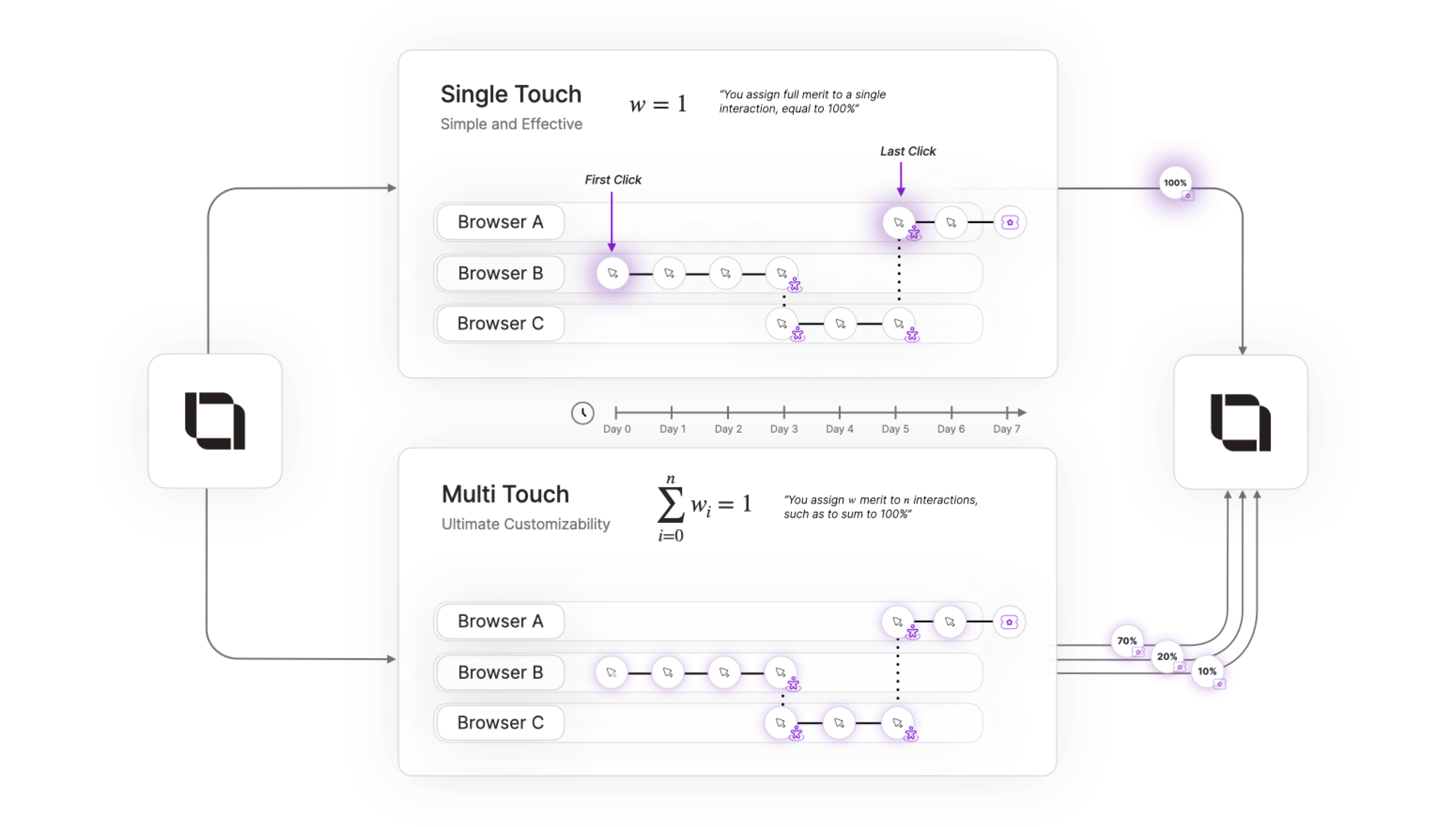
**Merit-Based Routing** ensures that when multiple advertising platforms claim credit for the same conversion, only the platform that wins attribution receives the conversion data. This prevents double-counting and ensures each platform's bidding algorithms optimize on non-overlapping data.
**Understanding attribution overlap:**
When a user interacts with multiple ad platforms before converting, each platform may claim credit:
* User clicks Google ad → browses site → clicks Meta ad → purchases
* Both Google and Meta claim the conversion
* Without merit-based routing, both receive conversion data, causing double-counting
OneView applies your attribution model to determine which platform gets credit, then routes the conversion only to that platform.
## How Merit-Based Routing works
OneView collects touchpoints from all sources, applies your attribution model, and routes the conversion only to the winning platform:
| Step | Action | Result |
| ------------------------------ | ------------------------------------------------------------------------- | --------------------------------------- |
| **1. Collect touchpoints** | Gather all ad interactions (clicks, views) from all platforms | Multiple platforms may have touchpoints |
| **2. Apply attribution model** | Use your chosen model (first-touch, last-touch, etc.) to determine winner | Single platform wins attribution |
| **3. Route conversion** | Send conversion data only to the winning platform | Other platforms receive nothing |
Merit-based routing works automatically with all [Conversion API integrations](/docs/integrations/overview). No configuration required.
## Attribution models
You can configure the attribution model on a per-event basis in your OneView workspace:
## What is Merit-Based Routing?
**Merit-Based Routing** ensures that when multiple advertising platforms claim credit for the same conversion, only the platform that wins attribution receives the conversion data. This prevents double-counting and ensures each platform's bidding algorithms optimize on non-overlapping data.
**Understanding attribution overlap:**
When a user interacts with multiple ad platforms before converting, each platform may claim credit:
* User clicks Google ad → browses site → clicks Meta ad → purchases
* Both Google and Meta claim the conversion
* Without merit-based routing, both receive conversion data, causing double-counting
OneView applies your attribution model to determine which platform gets credit, then routes the conversion only to that platform.
## How Merit-Based Routing works
OneView collects touchpoints from all sources, applies your attribution model, and routes the conversion only to the winning platform:
| Step | Action | Result |
| ------------------------------ | ------------------------------------------------------------------------- | --------------------------------------- |
| **1. Collect touchpoints** | Gather all ad interactions (clicks, views) from all platforms | Multiple platforms may have touchpoints |
| **2. Apply attribution model** | Use your chosen model (first-touch, last-touch, etc.) to determine winner | Single platform wins attribution |
| **3. Route conversion** | Send conversion data only to the winning platform | Other platforms receive nothing |
Merit-based routing works automatically with all [Conversion API integrations](/docs/integrations/overview). No configuration required.
## Attribution models
You can configure the attribution model on a per-event basis in your OneView workspace:
 | Model | Description | Best For |
| --------------- | ----------------------------------------------- | ---------------------------------- |
| **First-Touch** | Credits the first marketing interaction | Long sales cycles, brand awareness |
| **Last-Touch** | Credits the final interaction before conversion | E-commerce, quick decisions |
First-touch and Last-touch models can be combined and customized for different steps in your customer journey. For example:
* **First-touch** for the first interaction with the brand
* **Last-touch** for the last interaction before conversion
This lets you model a more **complex customer journey**, without using Multi-Touch models, which cannot work on a **per-performance** basis (i.e. when using **affiliation networks**)
## Attribution-only integrations
Some integrations are configured as **attribution-only**, meaning OneView tracks their touchpoints for attribution but does not send conversion data back to their API.
| Integration Type | Touchpoints Tracked | Conversion Data Sent |
| -------------------- | ------------------- | ------------------------- |
| **Conversion API** | Yes | Yes (if wins attribution) |
| **Attribution-only** | Yes | No |
When an attribution-only platform wins attribution, the conversion is recorded in OneView but not sent anywhere. This allows you to measure the impact of platforms that don't have Conversion API integrations while maintaining accurate attribution.
## Benefits
**Accurate campaign optimization**
Each platform's bidding algorithms receive only conversions they actually won, preventing them from optimizing on overlapping data that inflates performance metrics.
**Prevents double-counting**
Without merit-based routing, the same conversion might be sent to multiple platforms, causing each to report inflated conversion numbers. OneView ensures each conversion is counted once.
**Consistent attribution**
Your attribution model is applied consistently across all platforms before any conversion data is sent, ensuring fair and accurate attribution.
## Common questions
OneView uses your attribution model to break ties. If multiple platforms have identical touchpoints (same timestamp, same source), the model's tie-breaking rules determine the winner.
For last-touch attribution, the most recent touchpoint wins. For first-touch, the earliest touchpoint wins.
When overlapping conversions occur, merit-based routing evaluates all touchpoints, including attribution-only platforms:
1. OneView collects touchpoints from all sources (attribution-only via UTM, Conversion API platforms via click identifiers)
2. Your attribution model determines which touchpoint gets credit
3. **If the winner is a Conversion API platform** (e.g., Google Ads, Meta), OneView sends the conversion to that platform's API
4. **If the winner is attribution-only**, the conversion is recorded in OneView but not sent anywhere
5. Attribution-only platforms remain visible in reports showing they were part of the customer journey
Yes. OneView reports show the attributed source for each conversion, allowing you to see which platform received credit based on your attribution model.
## Next steps
Understand how OneView processes conversions and applies attribution models.
Learn how OneView prevents duplicate conversions across platforms.
| Model | Description | Best For |
| --------------- | ----------------------------------------------- | ---------------------------------- |
| **First-Touch** | Credits the first marketing interaction | Long sales cycles, brand awareness |
| **Last-Touch** | Credits the final interaction before conversion | E-commerce, quick decisions |
First-touch and Last-touch models can be combined and customized for different steps in your customer journey. For example:
* **First-touch** for the first interaction with the brand
* **Last-touch** for the last interaction before conversion
This lets you model a more **complex customer journey**, without using Multi-Touch models, which cannot work on a **per-performance** basis (i.e. when using **affiliation networks**)
## Attribution-only integrations
Some integrations are configured as **attribution-only**, meaning OneView tracks their touchpoints for attribution but does not send conversion data back to their API.
| Integration Type | Touchpoints Tracked | Conversion Data Sent |
| -------------------- | ------------------- | ------------------------- |
| **Conversion API** | Yes | Yes (if wins attribution) |
| **Attribution-only** | Yes | No |
When an attribution-only platform wins attribution, the conversion is recorded in OneView but not sent anywhere. This allows you to measure the impact of platforms that don't have Conversion API integrations while maintaining accurate attribution.
## Benefits
**Accurate campaign optimization**
Each platform's bidding algorithms receive only conversions they actually won, preventing them from optimizing on overlapping data that inflates performance metrics.
**Prevents double-counting**
Without merit-based routing, the same conversion might be sent to multiple platforms, causing each to report inflated conversion numbers. OneView ensures each conversion is counted once.
**Consistent attribution**
Your attribution model is applied consistently across all platforms before any conversion data is sent, ensuring fair and accurate attribution.
## Common questions
OneView uses your attribution model to break ties. If multiple platforms have identical touchpoints (same timestamp, same source), the model's tie-breaking rules determine the winner.
For last-touch attribution, the most recent touchpoint wins. For first-touch, the earliest touchpoint wins.
When overlapping conversions occur, merit-based routing evaluates all touchpoints, including attribution-only platforms:
1. OneView collects touchpoints from all sources (attribution-only via UTM, Conversion API platforms via click identifiers)
2. Your attribution model determines which touchpoint gets credit
3. **If the winner is a Conversion API platform** (e.g., Google Ads, Meta), OneView sends the conversion to that platform's API
4. **If the winner is attribution-only**, the conversion is recorded in OneView but not sent anywhere
5. Attribution-only platforms remain visible in reports showing they were part of the customer journey
Yes. OneView reports show the attributed source for each conversion, allowing you to see which platform received credit based on your attribution model.
## Next steps
Understand how OneView processes conversions and applies attribution models.
Learn how OneView prevents duplicate conversions across platforms.